
Ingredients
Every ingredient, explained like you are standing in our lab.
Every sachet starts with Australian honey and Australian Manuka honey certified MGO 250+, then saffron extract, fermented saffron and a proprietary Australian probiotic. Bright AM (kids) and Rise AM (adults) add vitamin C from acerola cherry for the morning; Rise AM adds a green tea lift. Dream PM (kids) and Restore PM (adults) add tart cherry, chamomile and lemon balm for the evening; Restore PM adds passionflower. Here is what each one is, where it comes from and why we chose it.
The six layers
- Honey base: 80% Australian honey, 20% Manuka MGO 250+The base of every sachet, kids and adults. Genuine Australian honey with certified MGO 250+ Manuka blended in.
- affron saffron extract, 14 mg in every sachetThe same standardised extract of Crocus sativus stigma in all four sachets: the form and the amount used in eleven published placebo-controlled trials. Standardised to more than 3.5% Lepticrosalides, saffron's own bioactive compounds: 3.48% crocins and 0.03% safranal.
- Fermented saffron: 100 mg kids, 200 mg adultsWhole saffron fermented by a live culture. 5 mg of saffron in the kids' amount, 10 mg in the adults'; the rest is the postbiotic the fermentation made.
- xoBiome MoodBalance probiotic: 100 mg kids, 200 mg adultsA multi-strain probiotic: four species in the morning sachets, a fifth for the evening.
- Morning extras: Bright AM (kids) and Rise AM (adults)Vitamin C from acerola cherry in both, 10 mg for kids and 20 mg for adults. Green tea in Rise AM only, about 40 mg of natural caffeine.
- Evening extras: Dream PM (kids) and Restore PM (adults)Tart cherry, chamomile and lemon balm in both: 350, 50 and 50 mg for kids; 480, 100 and 60 mg for adults. Passionflower 60 mg in Restore PM only.
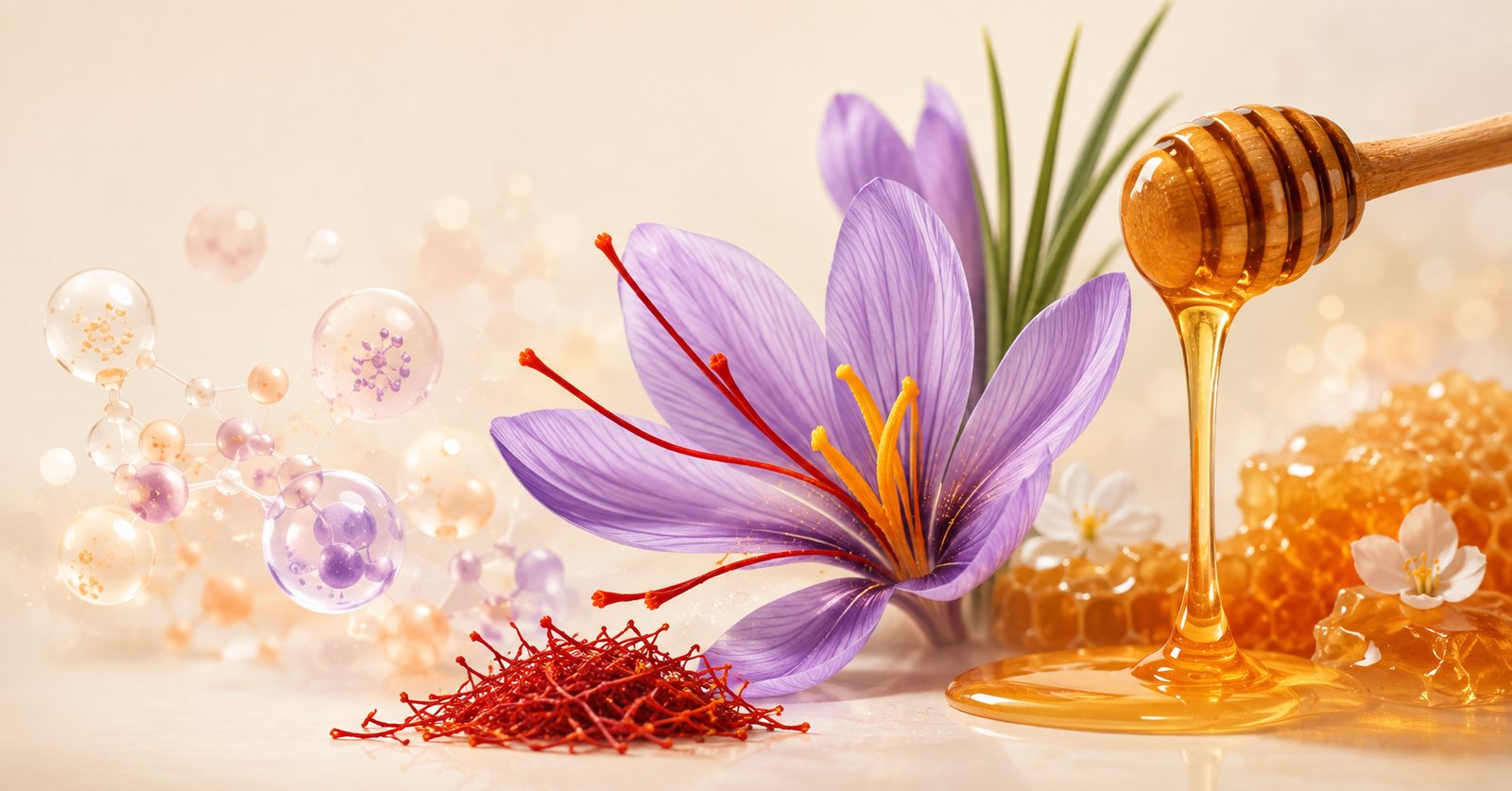
The ingredients
- 80 / 20Australian honey / Manuka MGO 250+
- 28 mgaffron extract a day, the trial amount. Fermented saffron on top.
- 11 trialsplacebo-controlled trials of affron
- From age 6kids, teens and adults
- 5 speciesin the probiotic
- Gold Coastwhere it is made
The hero ingredient
Saffron, two ways.
Saffron has flavoured and coloured Persian food and medicine for about three thousand years. Each crocus flower gives three threads, picked by hand at dawn. We put it in every sachet in two forms.
From flower to sachet
- One crocus flower
- Three threads from each flower
- Picked by hand at dawn
- Extracted and standardised
- Taken through fermentation
- Both forms in every sachet
Standardised extract
The threads are extracted and standardised so every sachet gets the same amount. Same colour, same measure, every morning and every night.
Fermented saffron
Whole saffron fermented by a live culture: 100 mg in each kids' sachet (5 mg of saffron) and 200 mg in each adult sachet (10 mg). The rest is the postbiotic, the cells and metabolites the fermentation made. Live cultures from the probiotic, plus what cultures make, in the same sachet.
Grown at Alborea in Albacete, Spain, and extracted with water alone in Madrid.
- Honey, 80% Australian honey
- Manuka, 20% Australian Manuka, MGO 250+
- Australia, where both come from
The base of both sachets
It starts with honey.
Honey is the base of both sachets. Ours is genuine 100% pure Australian honey from a family-owned Queensland honey house just up the road from us, thirty years in the trade, drawing on a network of trusted beekeepers across the country. It is the reason a Saffiome sachet tastes like something a child asks for, and it carries everything else in the formula.
And 20% Australian Manuka, certified MGO 250+.
One fifth of the honey in every sachet is Australian Manuka honey, certified MGO 250+. Manuka comes from bees working the flowers of Leptospermum, a native tree of Australia and New Zealand, and its grade is a number you can check: milligrams of methylglyoxal per kilogram, tested and certified on every batch. We chose it because honey is more than a sweetener. Its natural oligosaccharides feed Bifidobacteria and Lactobacilli in laboratory studies, and Manuka has been shown to support Bifidobacterium growth in probiotic milk.*
What MGO 250+ means
- MGO is methylglyoxal, a compound that forms naturally in Manuka honey from the nectar of Leptospermum flowers. Other honeys carry only traces of it.
- The number is milligrams per kilogram. MGO 250+ means at least 250 milligrams of methylglyoxal in every kilogram of the Manuka we blend in, certified on every batch. The grade most people know as UMF 10+ sits at about MGO 263.
- Why this grade: it is unmistakably Manuka in flavour, deeper and more herbaceous than the lower grades, and every number on it can be checked.
Manuka is 20% of the honey base and the Australian honey is the other 80%. MGO 250+ describes the Manuka. *Studies conducted on individual ingredients, not on Saffiome as a finished product. Individual results may vary.
- Honey and Manuka from a local, family-owned Queensland honey house, HACCP certified.
Ingredient by ingredient
Every ingredient, with its amount and its reason.
Eleven ingredients across the kids' and adult sachets, each one in plain English: what it is, where it comes from, why it is in the sachet, and what the research actually shows. Every study line carries the asterisk because the studies were on the ingredients, not on Saffiome. *Studies conducted on individual ingredients, not on Saffiome as a finished product. Individual results may vary.
From flower to base Australian honey
The prebiotic base, not a filler
In: All four: Bright AM and Dream PM (kids), Rise AM and Restore PM (adults)
Both sachets80% of the honey in every sachet is genuine 100% Australian honey from a family-owned Queensland honey house that has kept bees for more than thirty years, HACCP certified. It is the reason a six-year-old takes the sachet: no water, no pill, no chewing, no mixing, and the same taste every day. About 6 g of natural sugars per kids' sachet, with or without food.
- Where it comes from
- Australia, from our Queensland honey house
- Form
- Honey, 80% of the base
- Tradition
- Honey has a long history of use for digestive complaints across cultures, and it is one of the few foods with placebo-controlled trials in young children.
- Why we chose it
- Because honey is more than a sweetener. Its natural oligosaccharides feed Bifidobacteria and Lactobacilli in laboratory studies, and honey grew ten to a hundred times more lactobacilli than sugar in the lab, with higher counts in animals fed honey rather than sugar. That is why the base is honey and not syrup.
Research noteIn two placebo-controlled trials of children kept up by a cough (300 children aged 1 to 5; 105 aged 2 to 18), parents rated their child's sleep better after a spoon of honey before bed than after placebo.*
Australian Manuka Australian Manuka honey, certified MGO 250+
A premium grade you can check
In: All four: Bright AM and Dream PM (kids), Rise AM and Restore PM (adults)
Both sachets20% of the honey in every sachet is Australian Manuka, made by bees working the flowers of Leptospermum, a native tree of Australia and New Zealand. MGO is a grade: milligrams of methylglyoxal per kilogram, certified on every batch by an independent laboratory. MGO 250+ sits at the threshold of the grade most people know as UMF 10+.
- Where it comes from
- Australia, from our Queensland honey house
- Form
- Manuka honey, MGO 250+, 20% of the base
- Tradition
- The Manuka tree has a long place in Māori and Australian bush traditions; the honey came later, when European bees met Leptospermum flowers. Australian Manuka is legitimately Manuka: New Zealand's attempts to fence the name failed at the UK and New Zealand intellectual property offices in 2021 and 2023.
- Why we chose it
- A premium honey parents already recognise, with a certified grade we can print, and a gut-friendly one. Across 29 commercial Manuka honeys, measured MGO matched the label with mostly minor differences. It also deepens the flavour of the base.
Research noteManuka is studied for its effect on gut bacteria: in a four-week human trial, 20 g a day of high-grade Manuka left the gut's beneficial bacteria undisturbed, and in the lab Manuka supported Bifidobacterium growth in probiotic milk.*
How saffron is picked affron saffron extract
The hero, at the trial amount
In: All four: Bright AM and Dream PM (kids), Rise AM and Restore PM (adults)
Both sachetsSaffron is the dried stigma of the Crocus sativus flower, picked by hand at dawn, three threads to a flower, around 150 flowers to a gram. affron is a concentrated extract of those stigmas, made in Spain by Pharmactive and guaranteed at 3.5% Lepticrosalides, the crocins and safranal that give saffron its colour and scent. 14 mg is a dense, standardised amount: small number, big punch, and expensive per milligram.
- Where it comes from
- Spain (extract made by Pharmactive, Madrid)
- Form
- Standardised extract, 3.5% Lepticrosalides; 14 mg per sachet, kids and adults; 28 mg a day across two sachets
- Tradition
- Saffron has three thousand years of history in Persian food and medicine, and the strongest modern research of any food ingredient for mood.
- Why we chose it
- affron is the saffron extract with the most placebo-controlled trials, nine on PubMed, and the only one with a trial in teenagers. Two sachets a day is 28 mg, the same daily amount and the same morning-and-evening split that trial used. One sachet is half the routine.
Research noteIn an 8-week trial, teens aged 12 to 16 taking 14 mg of affron twice a day saw a 33% drop in worry and low-mood symptoms against 17% on placebo; in a 12-week trial of 202 adults, 72.3% on 28 mg a day had a meaningful lift in mood score against 54.3% on placebo; in a 28-day trial of 120 adults with poor sleep, 14 mg before bed improved sleep quality ratings against placebo.*
Saffron, fermented Fermented saffron
The postbiotic ingredient
In: All four: Bright AM and Dream PM (kids), Rise AM and Restore PM (adults)
Both sachetsA whole fermented material, not an extract. Whole saffron is fermented by a live culture; the finished ingredient is 5% saffron by weight, and the other 95% is the fermentation base and the postbiotic: the cells and metabolites the fermentation made. So each kids' sachet carries about 19 mg of saffron in total (14 mg from affron, 5 mg from here) and each adult sachet about 24 mg (14 mg and 10 mg).
- Where it comes from
- Fermented on the Gold Coast
- Form
- Whole fermented material, 5% saffron by weight; 100 mg per kids' sachet (5 mg saffron), 200 mg per adult sachet (10 mg saffron)
- Tradition
- In the gut, microbes convert saffron's crocins into crocetin, the form found in the blood after saffron is eaten, within hours. Fermenting whole saffron applies the same kind of microbial process before it reaches the sachet.
- Why we chose it
- Live cultures, plus what cultures make: xoBiome MoodBalance is the probiotic; the fermented saffron is the postbiotic. It is the gut-brain logic of the formula in one line, and it is saffron in its whole form alongside the concentrate.
Research noteNo trial tests this fermented saffron itself. The mechanism is established: gut microbes convert crocins to crocetin within hours (García 2024), and crocetin is the form measured in the blood after a saffron extract is taken (Almodóvar 2020).*
What a probiotic is xoBiome MoodBalance probiotic
Five species, five gut-brain stories
In: All four: Bright AM and Dream PM (kids), Rise AM and Restore PM (adults)
Both sachetsA multi-strain probiotic developed and made on the Gold Coast for the gut-brain axis. The morning sachets, Bright AM (kids) and Rise AM (adults), carry Lactobacillus helveticus, L. plantarum, L. rhamnosus and Bifidobacterium breve. The evening sachets, Dream PM (kids) and Restore PM (adults), add L. brevis, the GABA maker. Strain codes (XXXXXX) and live count per sachet (XXXXXX CFU at end of shelf life) are being confirmed with our manufacturer and will be printed here.
- Where it comes from
- Australia, developed and made on the Gold Coast
- Form
- Multi-strain probiotic blend; 100 mg per kids' sachet, 200 mg per adult sachet; four species in the morning, five in the evening
- Tradition
- The gut and the brain talk all day, through the vagus nerve, through hormones and through the immune system, and the bacteria in the gut join that conversation. The gut is where much of the body's serotonin is made and handled.
- Why we chose it
- Every species in it has its own research story: L. helveticus is half of the most-studied psychobiotic pairing; L. rhamnosus is the species behind the vagus nerve study that started the field; L. plantarum has a placebo-controlled trial in children; B. breve has trials for memory and mood; L. brevis was the most efficient GABA producer of 91 human gut bacteria tested.
Research noteSpecies-level studies: L. helveticus with a Bifidobacterium lowered psychological distress scores and urinary cortisol in a 30-day placebo-controlled trial; L. rhamnosus HN001 through pregnancy meant lower low-mood and worry scores after birth in 423 mothers; B. breve A1 improved memory scores against placebo in 80 older adults over 16 weeks. Studies were on named strains of each species, not on MoodBalance.*
Tart cherry Tart cherry
The evening fruit
In: Dream PM (kids) and Restore PM (adults)
Dream PMSour cherry, the Montmorency type, concentrated ten to one. Deep red from anthocyanins, and the reason the evening sachets taste like evening against the honey.
- Form
- 10:1 fruit extract; 350 mg per kids' sachet, 480 mg per adult sachet; Dream PM (kids) and Restore PM (adults)
- Tradition
- The fruit people reach for in the evening. Its compounds include procyanidins that, in laboratory work, help keep tryptophan available, the building block of the body's sleep and mood chemistry.
- Why we chose it
- Studied for sleep in adults. In a small trial, adults over 50 slept 84 minutes longer on tart cherry juice than on placebo, and in a 7-day trial of 20 adults, total sleep time and sleep efficiency both rose. The trials used juice, so we call it a studied ingredient, not a studied amount.
Research noteEight adults over 50 with insomnia slept 84 minutes longer on tart cherry juice than on placebo over 2 weeks, measured by overnight sleep study (Losso 2018).*
Chamomile, the evening classic Chamomile
The evening flower
In: Dream PM (kids) and Restore PM (adults)
Dream PMGerman chamomile, Matricaria, the small white flower behind Europe's evening tea for centuries. Its calming reputation comes from apigenin and related compounds.
- Form
- 10:1 flower extract; 50 mg per kids' sachet, 100 mg per adult sachet; Dream PM (kids) and Restore PM (adults)
- Tradition
- Chamomile's place in the last cup of the day goes back hundreds of years across Europe.
- Why we chose it
- Studied for calm in adults. In an 8-week trial, adults taking chamomile extract reported lower worry scores than those on placebo, and a 28-day trial in older adults found better sleep quality ratings than placebo. One trial in adults with long-term insomnia found no difference on sleep diaries, and we say so.
Research note57 adults with mild to moderate generalised anxiety, 8 weeks: worry scores fell more on chamomile than placebo (p = 0.047, Amsterdam 2009); 60 older adults, 200 mg twice a day for 28 days: better sleep quality ratings than placebo (Adib-Hajbaghery 2017).*
Lemon balm Lemon balm
The calm herb, studied in children
In: Dream PM (kids) and Restore PM (adults)
Dream PMMelissa officinalis, a lemon-scented member of the mint family, grown in monastery gardens since the Middle Ages and taken as a calming tea ever since. Its lemon note lifts the honey.
- Form
- 10:1 leaf extract; 50 mg per kids' sachet, 60 mg per adult sachet; Dream PM (kids) and Restore PM (adults)
- Tradition
- A calming tea since the Middle Ages, and the evening herb with the most study in kids under 12.
- Why we chose it
- In two German studies of more than a thousand children under 12, parents and paediatricians rated a lemon balm and valerian blend as improving restlessness and settling to sleep in most children. In adults, single doses raised self-rated calmness under a laboratory stress test. The child studies used a blend with valerian and had no placebo group.
Research note918 children under 12 with restlessness and trouble settling: sleep trouble improved in 80.9% and restlessness in 70.4% on a lemon balm and valerian blend (Müller 2006, open study); 18 adults: a single 600 mg dose reduced negative mood under a lab stressor and raised calmness ratings (Kennedy 2004).*
Vitamin C, from acerola Vitamin C, from acerola cherry
The daily vitamin
In: Bright AM (kids) and Rise AM (adults)
Bright AMAcerola is a small red cherry from the Americas with one of the highest natural vitamin C contents of any fruit. We use the powdered fruit in the morning sachets so the vitamin C comes from food, not a factory.
- Where it comes from
- Acerola cherry, powdered
- Form
- Acerola cherry powder; 10 mg vitamin C per kids' sachet, 20 mg per adult sachet; Bright AM (kids) and Rise AM (adults)
- Tradition
- Cherries, citrus and berries were the original vitamin C: the fruit sailors carried, long before anyone had named the vitamin.
- Why we chose it
- Vitamin C is the one ingredient in Saffiome whose health claims Australian food law has already approved: it contributes to normal psychological function, to the normal functioning of the nervous system, and, at the adult amount, to the reduction of tiredness and fatigue. Ten milligrams is about a quarter of the daily intake; twenty is about half.
Research noteVitamin C contributes to normal psychological function and to the normal functioning of the nervous system. Pre-approved general level health claims under Food Standard 1.2.7 (Schedule 4).
Green tea Green tea
The gentle lift
In: Rise AM (adults) only
Bright AMA whole-leaf green tea extract. It gives Rise AM about 40 mg of natural caffeine, roughly a cup of green tea, and it is the reason the adult morning sachet feels different from the kids' one. Green tea leaf naturally contains theanine, an amino acid found in tea and almost nowhere else in the diet. It is there because the leaf is there; we do not add it.
- Where it comes from
- Green tea leaf
- Form
- Whole-leaf extract, about 150 mg per adult sachet, about 40 mg caffeine; Rise AM (adults) only
- Tradition
- Green tea has been the morning drink of East Asia for more than a thousand years, taken for the lift and the ritual.
- Why we chose it
- Adults asked for a morning sachet with a little more in it. Green tea gives a gentle lift without a second coffee, and it comes from a leaf people already know. If caffeine bothers you, take Rise AM early in the day.
Passionflower Passionflower
The adult evening herb
In: Restore PM (adults) only
Dream PMPassiflora incarnata, the flowering vine, concentrated ten to one. It joins tart cherry, chamomile and lemon balm in the adult evening sachet.
- Where it comes from
- Passionflower vine
- Form
- 10:1 extract, 60 mg per adult sachet; Restore PM (adults) only
- Tradition
- A traditional evening tea in the Americas and later Europe, taken before bed for generations.
- Why we chose it
- The adult evening deserves one more studied herb. In a crossover trial, adults rated their sleep quality better after a week of passionflower tea than after placebo tea. Adults only.
Research note41 adults aged 18 to 35 drank passionflower tea or placebo tea each evening for a week, in a crossover design; sleep quality ratings were significantly better on passionflower (Ngan and Conduit 2011).*
Kids and teens, 6 to 17
The kids' sachets: two sachets, one formula.
Bright AM (kids) and Dream PM (kids) share the same honey base and the same three core ingredients. Bright AM adds vitamin C from acerola cherry for the morning. Dream PM adds tart cherry, chamomile and lemon balm for the evening. The adult sachets follow below.
Bright AM (kids) Morning sachet, 8 g, ages 6 to 17
- Australian honey80% of the base
- Australian Manuka honey, certified MGO 250+20% of the base
- Saffron extract14 mg
- Fermented saffron100 mg (5 mg saffron)
- xoBiome MoodBalance probiotic100 mg
- Vitamin C, from acerola cherry10 mg
6 ingredients in Bright AM (kids)
Dream PM (kids) Evening sachet, 8 g, ages 6 to 17
- Australian honey80% of the base
- Australian Manuka honey, certified MGO 250+20% of the base
- Saffron extract14 mg
- Fermented saffron100 mg (5 mg saffron)
- xoBiome MoodBalance probiotic100 mg
- Tart cherry350 mg
- Chamomile50 mg
- Lemon balm50 mg
8 ingredients in Dream PM (kids)
- Honey base
- Core ingredients, in both
- Morning or evening extras
Grown-ups
The adult sachets: the same formula, sized up, with a morning lift.
Rise AM (adults) and Restore PM (adults) share the base and the core with more of each. Rise AM adds vitamin C and a green tea lift for the morning. Restore PM adds tart cherry, chamomile, lemon balm and passionflower for the evening.
Rise AM (adults) Morning sachet, 10 g, 18 and over
- Australian honey80% of the base
- Australian Manuka honey, certified MGO 250+20% of the base
- Saffron extract14 mg
- Fermented saffron200 mg (10 mg saffron)
- xoBiome MoodBalance probiotic200 mg
- Vitamin C, from acerola cherry20 mg
- Green tea extractabout 40 mg caffeine
7 ingredients in Rise AM (adults)
Restore PM (adults) Evening sachet, 10 g, 18 and over
- Australian honey80% of the base
- Australian Manuka honey, certified MGO 250+20% of the base
- Saffron extract14 mg
- Fermented saffron200 mg (10 mg saffron)
- xoBiome MoodBalance probiotic200 mg
- Tart cherry480 mg
- Chamomile100 mg
- Lemon balm60 mg
- Passionflower60 mg
9 ingredients in Restore PM (adults)
- Honey base
- Core ingredients, in both
- Morning or evening extras
Origin
Where it comes from.
The honey is Australian, from a family-owned Queensland honey house. The formula is made, blended and fermented on the Gold Coast. The saffron extract comes from Spain. The rest of the origins are listed here as we confirm them, ingredient by ingredient.
- Gold Coast, QueenslandMade, blended and fermented
- Queensland honey houseFamily-owned, 80% Australian honey, 20% Manuka, certified MGO 250+
- Spainaffron saffron extract, made by Pharmactive in Madrid
Ingredient origins
- Australian honey Australia Confirmed
- Australian Manuka honey, certified MGO 250+ Australia Confirmed
- affron saffron extract Spain (Pharmactive, Madrid) Confirmed
- Fermented saffron Fermented on the Gold Coast, Queensland Confirmed
- xoBiome MoodBalance probiotic Developed and made on the Gold Coast, Queensland Confirmed
Quality
How carefully it is made.
Here is how a sachet gets from the hive to your kitchen. Each step joins this list as it is documented.
From hive to sachet
-
Blended and filled on the Gold Coast
Every sachet is blended and filled by our manufacturing partner on the Gold Coast, Queensland.
Parent Stories
What families say.
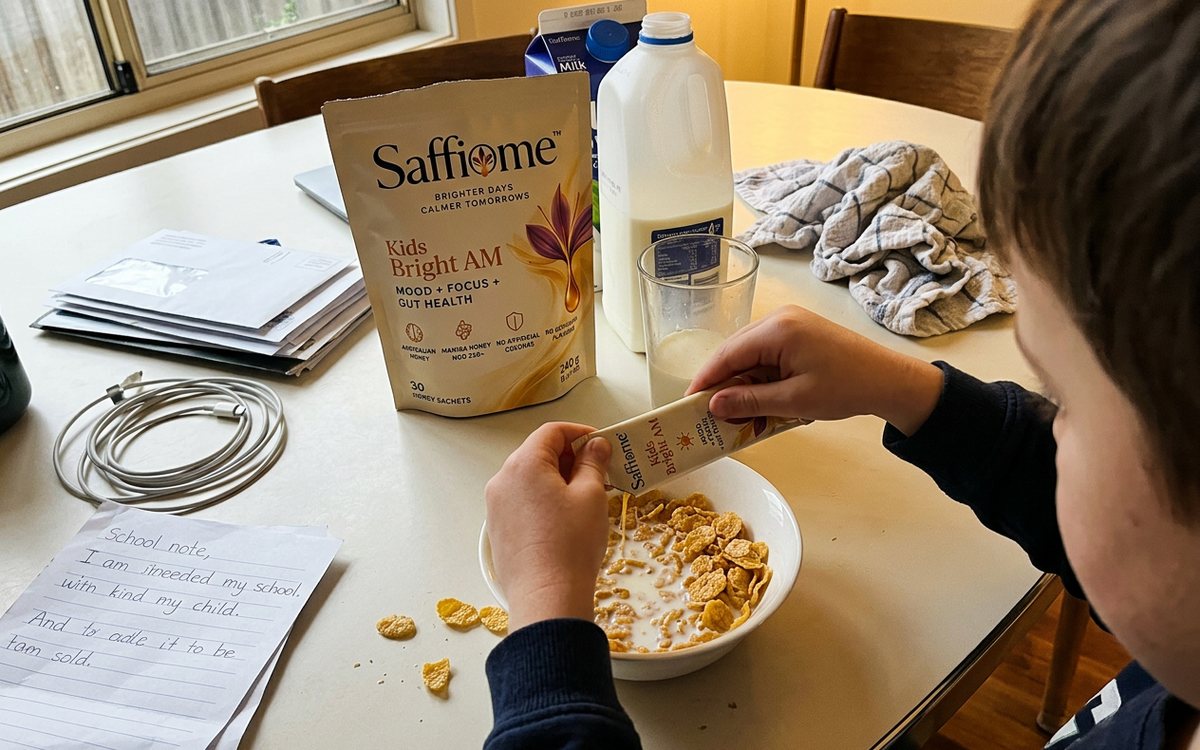
Mornings in our house used to start with a negotiation. Now the sachet goes on the table next to the cereal and that is that. She calls it her sunshine honey.
Kate M., Burleigh Heads, mum of a 7-year-old
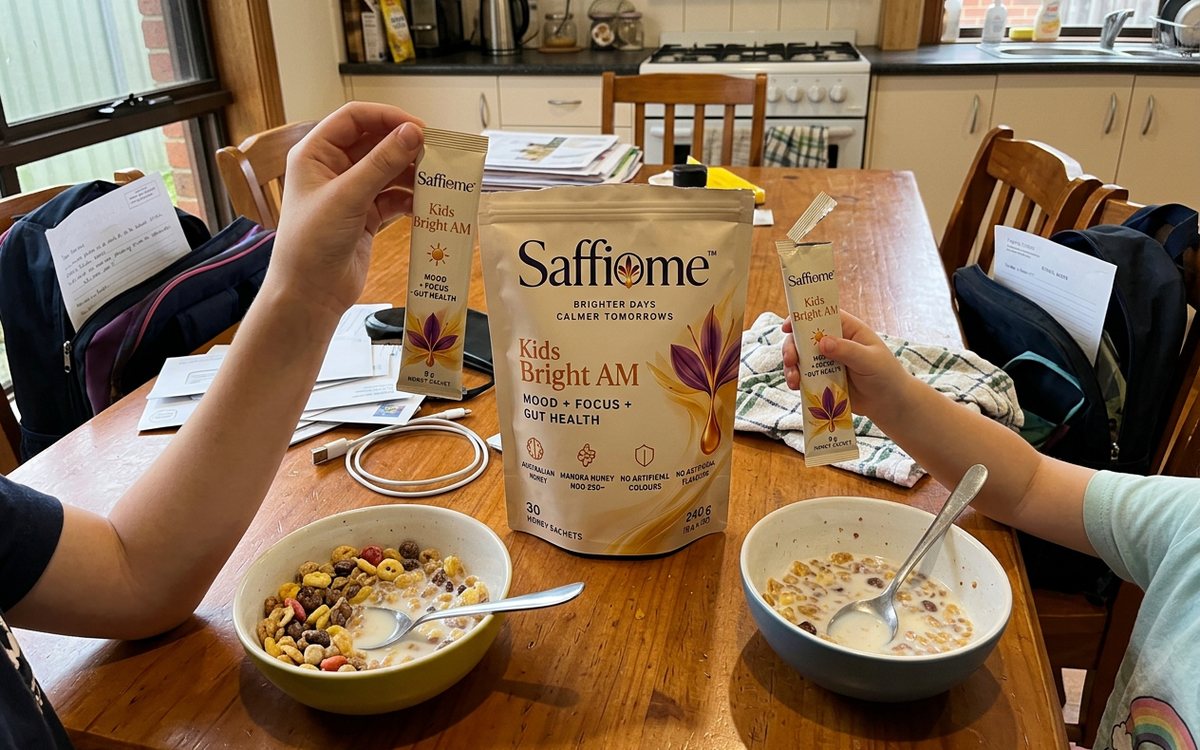
Both boys have busy brains and both take it without a fight, which is more than I can say for anything else we have tried. Same taste every day is the whole trick.
Daniel R., Newcastle, dad of two, 6 and 9
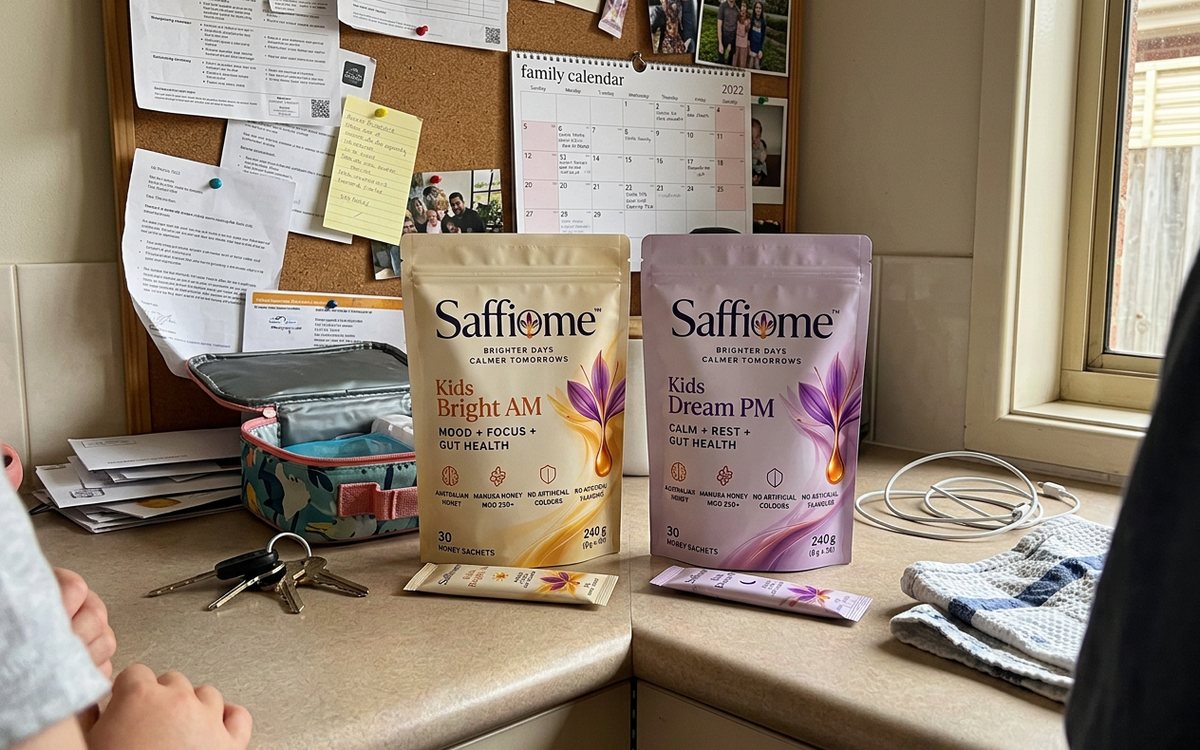
We run OT, a psych and a school plan. This slotted in without changing any of it. It fits right in with what you already do, exactly as it says.
Priya S., Melbourne, mum of an 8-year-old
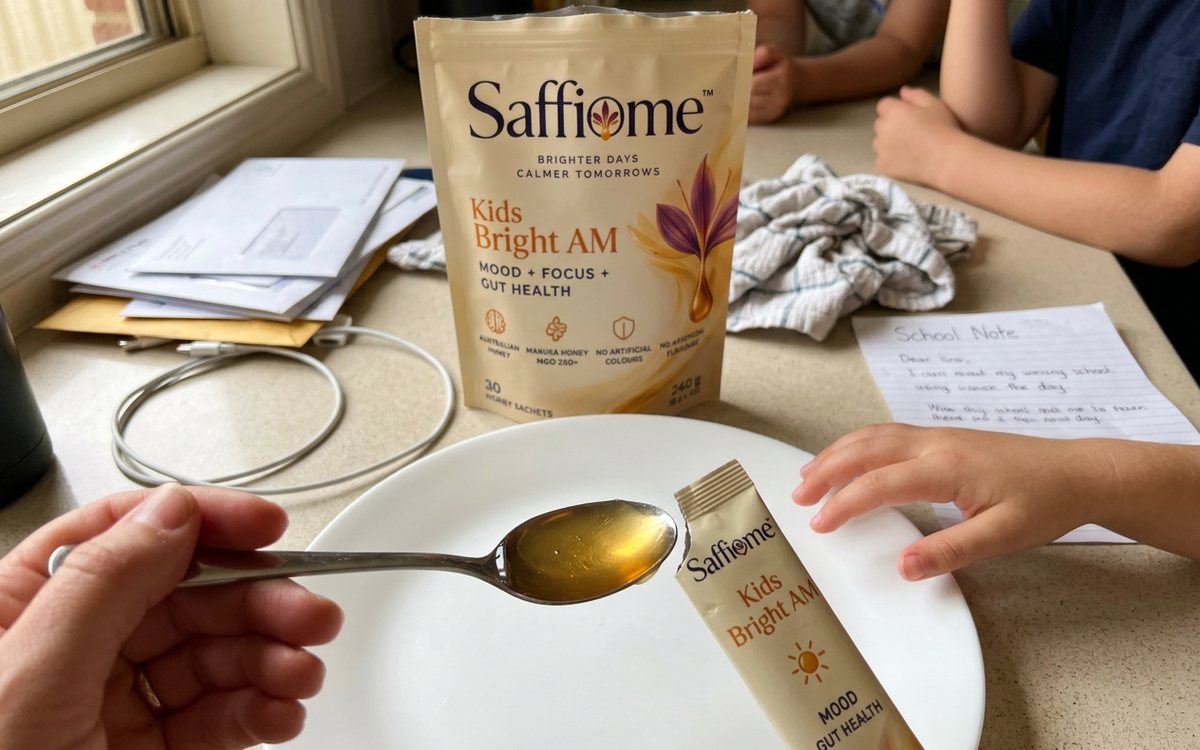
Sensory kid. Textures are a battlefield. Smooth honey, no bits, no pills, and it is the same every single time. That is why it stuck.
Marcus L., Perth, dad of a 6-year-old
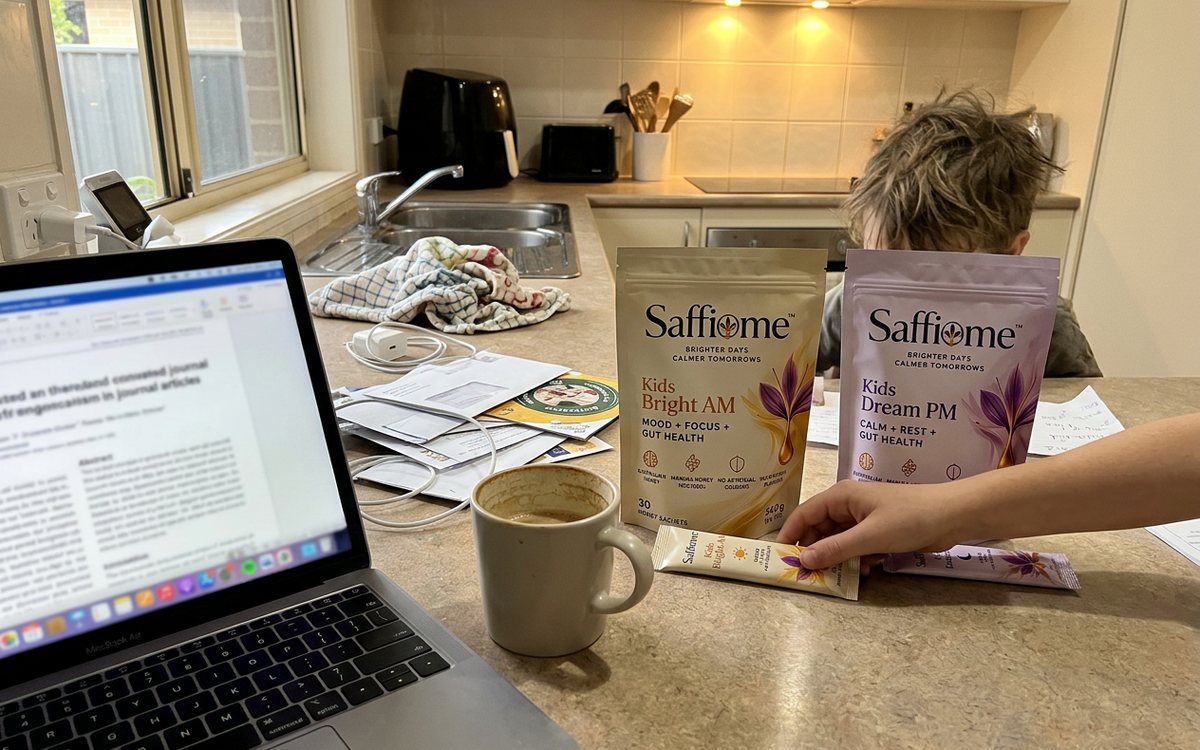
I read the teen study before I bought. Same amount of saffron, split the same way. That honesty is why we are here.
Tom W., Canberra, dad of a 12-year-old
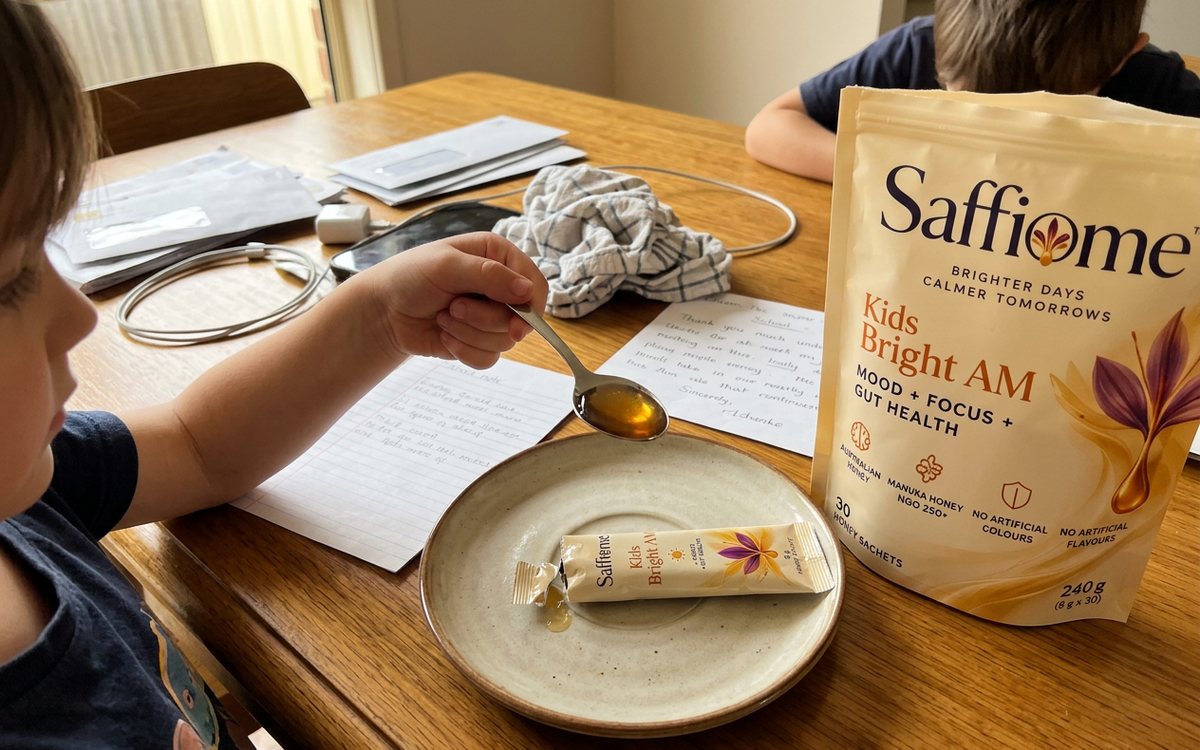
He is our sensory kid and new foods are a negotiation that can take a month. Honey was not a negotiation. Day one, spoon, done. That alone was worth it.
Chloe D., Hobart, mum of a 6-year-old
Questions about the ingredients
How much saffron is in a sachet?
Kids' sachets: 14 mg of affron, the standardised extract (3.5% Lepticrosalides), plus 100 mg of fermented saffron, which carries 5 mg of saffron. Adult sachets: the same 14 mg of affron, plus 200 mg of fermented saffron, which carries 10 mg of saffron. Two sachets a day is 28 mg of affron for kids and adults alike, the daily amount and the morning-and-evening split used in the clinical trials. Add the saffron inside the fermented saffron and the day's total is about 38 mg for kids and about 48 mg for adults.
Which probiotic species are in it?
The morning sachets, Bright AM (kids) and Rise AM (adults): Lactobacillus helveticus, L. plantarum, L. rhamnosus and Bifidobacterium breve. The evening sachets, Dream PM (kids) and Restore PM (adults), add L. brevis. The strain codes and the live count per sachet are being confirmed with our manufacturer and will be printed here; until then the cards show XXXXXX where the fact is pending.
What is a postbiotic?
A preparation of inanimate microorganisms and their components, the cells and the compounds a fermentation made. In Saffiome the fermented saffron carries the postbiotic, and xoBiome MoodBalance carries the live probiotic: live cultures, plus what cultures make.
What does MGO 250+ mean?
MGO is methylglyoxal, a compound that forms naturally in Manuka honey from the nectar of Leptospermum. The number is milligrams per kilogram, so MGO 250+ means at least 250 milligrams in every kilogram of the Manuka we blend in, certified on every batch. It sits at the threshold of the grade most people know as UMF 10+. Manuka is 20% of the honey base; the MGO grade describes the Manuka, not the whole sachet.
Where does the honey come from?
Both the honey and the Manuka come from a local, family-owned Queensland honey house, thirty years in the trade and HACCP certified, sourcing genuine 100% pure Australian honey from a network of trusted beekeepers across the country.
Is there sugar in it?
Each kids' sachet has about 6 g of sugar and each adult sachet about 7 g, all of it from the honey. Two kids' sachets a day is about 12.5 g, or three teaspoons; two adult sachets about 15 g, or under four. That is the honey doing its job as the food that carries everything else. The morning sachet starts the day and the evening sachet goes about an hour before bed, so it is done before teeth are brushed.
Why honey for kids?
Honey is a food children already know, and it carries the rest of the formula. Bright AM and Dream PM are for kids and teens 6 to 17; Rise AM and Restore PM are the adult sachets, 18 and over. Honey is never for babies under 12 months.
Is the honey organic?
Our honey is 100% Australian. We will only use the word organic if the supplier's certification lets us, and we will show the certificate here when we do.
Where does the saffron come from?
The saffron extract, affron, is made in Spain by Pharmactive from Crocus sativus stigmas and standardised to 3.5% Lepticrosalides. The fermented saffron is fermented on the Gold Coast. Every other origin is printed above and on the pouch.
What is fermented saffron?
Two things. affron is a concentrated extract: 14 mg is a dense, standardised amount of saffron's active compounds, guaranteed at 3.5% Lepticrosalides, the same thing the trials used. Fermented saffron is a whole fermented material: 100 mg in a kids' sachet provides 5 mg of saffron, 200 mg in an adult sachet provides 10 mg, and the other 95% is the postbiotic, the cells and metabolites the fermentation made. So each kids' sachet carries about 19 mg of saffron and each adult sachet about 24 mg, plus a live probiotic and a postbiotic side by side.
Ingredients
Morning and night, every ingredient explained.
Founding Member: $99 a month for life on the Kids Day-Night Bundle, for the first 100.